

There is a specific kind of frustration that comes with being a creator who cannot “see.” Most people assume that creativity is a visual pipeline, a straight line from a mental image to a physical stroke of a brush or a line on a page. But for those of us with aphantasia, that pipeline is blocked. Our waking minds are made of concepts and data, moving through a world where we know exactly what a sunset is without ever needing to see it behind our eyelids. However, the rules seem to change the moment we fall asleep.
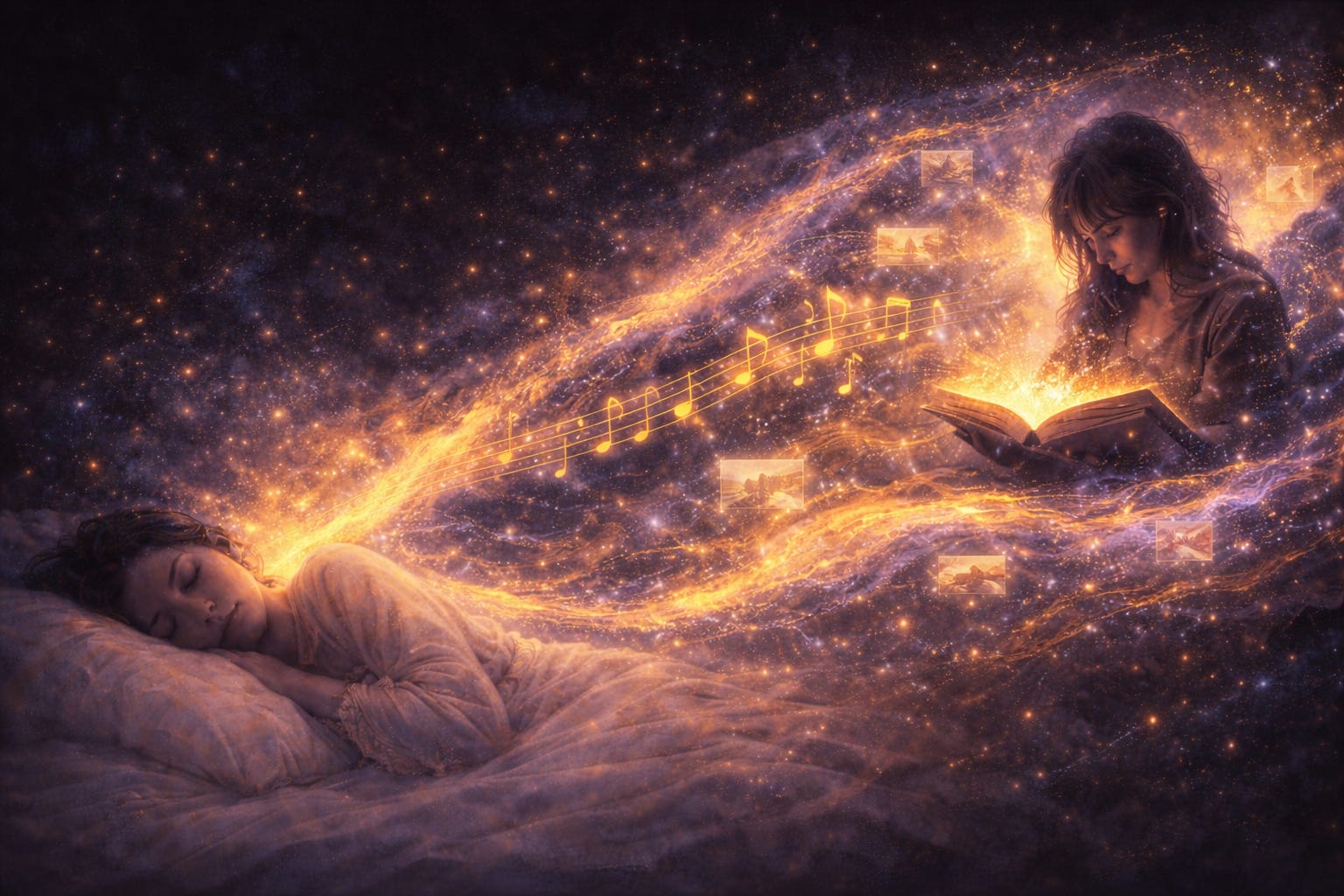
Personally, I found through conversations with other aphants that many of us are deeply artistic. Even more fascinating is that for some, the visual block only exists while they are awake. When they fall asleep, the screen flickers to life, and they experience vivid, cinematic dreams. In my experience, some creators with aphantasia use these dreams as a primary source of inspiration. They aren’t just dreaming; they are scouting. They witness colors, complex musical arrangements, and fully developed characters in their sleep that they could never summon in their imagination during the day.
I should clarify that, personally, I am not some deeply gifted artist; I’m more of a wannabe crafter and creator. But even for those of us just trying to make something meaningful, these dreams offer a rare glimpse into a vivid world. For these creators, the act of summoning the work only happens once they start the physical process. They aren’t calling up a mental picture to copy; they are summoning the vision into their art as they create it. The canvas, the staff paper, or the keyboard becomes the only place where the dream can finally be seen or heard again.
This creates a unique creative process: the Midnight Scout. Instead of sitting down and trying to visualize a finished product, these creators are trying to transcribe a memory of something they actually experienced in the dream world. It is less about imagining and more about reporting.
I think back to my own history with Mall world. It is a vivid, recurring landscape I still periodically visit, though it is become clear to me that those nocturnal travels have nothing to do with any specific talents or lack thereof in my waking life. It is simply a place I go. But for the creator, these places and the people within them can become the blueprints for real world work.
Imagine this scenario: You are deep in a dream where you are standing before a massive, textured wall of deep indigo and gold. Or perhaps you are hearing a melody with a specific, haunting cadence, or watching a character move with a limp and a very specific set of silver rings on their fingers. You can see the way the light hits the ridges of the paint, hear the intervals of the chords, or notice the weight of the character’s presence. As a writer, you might even see the exact expression of grief on a protagonist’s face or notice the specific way they lean against a doorway: details you could never manufacture while awake.
The moment you wake up, instead of reaching for a light switch and letting the experience dissolve, you stay still. You follow a somatic anchor, keeping your body in that same dreamt position. You grab your phone and record a quick voice memo, not describing the beauty, but the spatial and structural facts. The gold was a heavy vertical strike on the left. The melody shifted from a minor third to a major fifth. That character had a voice like gravel and leaned heavily to the right. You tag it conceptually as metallic armor, ocean floor, or weighted sorrow.
As the day moves on and your internal screen goes dark again, those notes remain. When you finally sit at your desk, you aren’t staring into a blank void trying to remember a ghost. You are just following a map. By the time the sun sets, that indigo and gold are actually there on your canvas. Those chords are on your paper, or that character is real on the page with their silver rings and their gravelly voice. You didn’t need to see it in your head to make it real; you just needed to build a bridge from the dream to the physical world.
The struggle for an aphant creator isn’t just the standard fading of a dream; it is the total loss of the source file. All dreamers experience a decay rate, but for those who can visualize, they often have a lingering mental snapshot, a blurry polaroid they can glance at while they reach for a pen. For us, the decay is absolute because we lack a visual backup drive. The moment our eyes open and our waking mind takes over, the screen doesn’t just dim: it unplugs. We can’t look back at the dream image to double check the shade of a character’s eyes or the specific curve of a melody’s bridge. What remains is the knowing, but the playback vanishes. To bring that work into the real world, we have to bridge the gap between the vivid dream and the conceptual wakefulness.
If you want to use your dreams as a creative resource but struggle to hold onto the images, here is the process I’ve noticed helps bridge the gap:
The Somatic Anchor: Before you open your eyes or move, stay in the exact physical position you woke up in. Try to recall the “weight” of the dream and how your body felt in that space.
The Voice First Journal: Don’t wait to find a pen. Use a voice memo app the second you wake up. Describe the spatial layout, the rhythm of the sounds, or the feeling of the light before the memory fades.
Conceptual Tagging: List specific attributes instead of visual descriptions. Use words like industrial, neon, sharp, or fluid to act as conceptual breadcrumbs that lead you back to the spark later in the day.
Ultimately, I believe that we aren’t broken dreamers. We are just travelers who have to be a bit more diligent about taking notes before we cross the border back into the waking world. The dream world is a place where our screens finally turn on. Our job is simply to find a way to carry those colors and sounds back into the light.
SUBSCRIBE & BUILD WITH ME
Ready to unlock your own midnight studio?
Subscribe now to get exclusive access to the development of Vessel & Volume. I’m building this app specifically for our community, moving away from “visualizing” and toward a somatic, body led experience that uses resonant vibration and spatial anchors to ground you in the here and now. Personally, I’ve noticed that the weight of your own presence can anchor a memory far better than a flickering image ever could. As a subscriber, you’ll get to help me test these physical anchors and build the tool we’ve actually been waiting for.
“What remains is the knowing, but the playback vanishes.”
This is the idea I want to share with folks who are new to the concept of aphantasia. I wrote a piece called “I Remember the Seeing” that parallels your line.